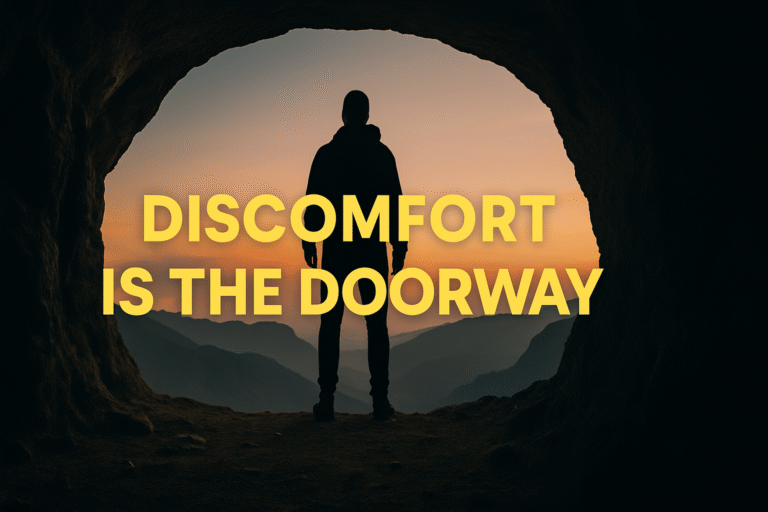
Discomfort is the Doorway: Why Spontaneity Feels Weird (and Why That’s a Good Thing)
Ever notice that the moments you remember most weren’t the ones where you were perfectly comfortable?
Growth rarely happens wrapped in a blanket on the couch.
It happens when you step into something unfamiliar… and feel that little jolt in your chest that says,
“This could go terribly… or it could be amazing.”
That feeling? That’s the doorway.
And the only way to walk through it is to embrace a little discomfort.
Why Discomfort Feels So Uncomfortable (and Why It’s Vital)
Your brain is designed to keep you safe. Safe = familiar.
So when you consider doing something spontaneous—taking the mic, booking the trip, saying yes to the invite—your nervous system sometimes throws a mini tantrum.
It’s not danger.
It’s simply different.
And different is where growth lives.
Psychologists call this optimal anxiety—that small stretch outside your comfort zone where learning and expansion happen. Too little? You stagnate. Too much? You panic. But just enough? That’s where you level up.
Spontaneity as a Growth Tool
When you practice spontaneity, you’re essentially training your mind and body to be okay with discomfort. You’re saying:
I can walk into this without all the answers.
I can feel unsure and still act.
I can trust that I’ll figure it out along the way.
Over time, that skill spills into every area of life—work, relationships, creativity. You become more adaptable, more confident, and more likely to seize opportunities others avoid.
Real-Life Example: The Queens Basket Brigade
I’ll never forget being asked to lead the Queens Basket Brigade—a massive Thanksgiving meal delivery initiative.
I had never run something like that before.
Every part of me wanted to hide behind excuses:
But I said yes.
And because I did, I learned leadership on the fly, saw a community come together, and helped deliver hundreds of meals to families who needed them.
Today, that event still runs without me—and I’m proud to have been part of its origin.
None of it would’ve happened if I waited to feel ready.
How to Lean Into Discomfort Without Burning Out
Start Small
Say yes to a coffee with a stranger, try a new class, wear something bolder than usual. Little stretches add up.
Notice the Story
When you feel resistance, ask:
“Is this actually unsafe, or just unfamiliar?”
Most of the time, it’s the latter.
Anchor the Win
After you push through, take a moment to note what you gained—skills, confidence, connections. This reinforces your willingness to do it again.
Your Challenge This Week:
Pick one thing that feels just a little uncomfortable. Not terrifying. Just outside your normal.
Do it.
Then, reflect:
How did I feel before, during, and after?
What did I learn about myself?
Would I do it again?
SpontaneousAF Credo: Discomfort is a Sign of Growth.
If it feels new and a little awkward, you might be exactly where you’re supposed to be.